Tesla FSD Sees What Human Eyes Cannot. I'm a Little Less Skeptical Today.
I’m skeptical of Tesla’s camera+radar (no Lidar) approach to autonomous driving. The sensor fusion debate has raged for years and the lidar camp has strong arguments.
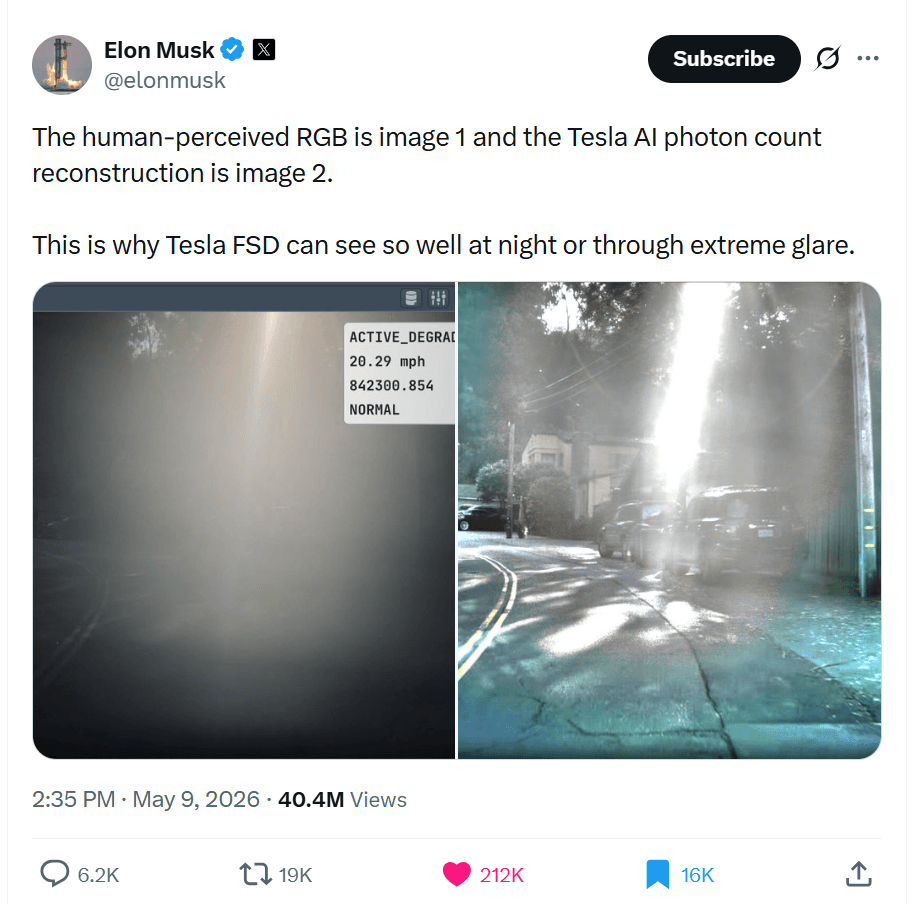
Then Elon posted the image below.
The image on the left is what a human eye sees in extreme glare. Effectively nothing. The image on the right is what Tesla FSD sees after AI-based photon count reconstruction from the same camera sensor. A fully recoverable road scene.
This is not replicating human vision. This is exceeding it.
Tesla is not just using cameras the way humans use eyes. They are applying signal processing and neural reconstruction to extract information from raw photon data that human vision cannot perceive at all. That changes the framing of the entire debate.
The question was always: can cameras and radar, without lidar, provide enough information to drive safely? That depends on what you do with the photons.
The lidar debate is far from over. Both cameras and lidar struggle in heavy precipitation. But in low light conditions lidar has a clear advantage, it generates its own light and does not depend on ambient illumination. That is a real difference worth keeping in mind.
(Yes, I’m a little less skeptical today.)
Want longer reads on these topics?
Insights covers the same topics in depth: research-backed analysis on AI, value creation, and building companies.
Read Zaruko Insights