A Memory Breakthrough Worth Tracking, Probably Not Soon.
One of AI infrastructure’s biggest bottlenecks is now power and cooling, not just raw compute. A new memory result is worth paying attention to, with the usual caveats.
University of Tokyo researchers demonstrated a non-volatile memory device that switches in 40 picoseconds. That puts it in the picosecond regime rather than the nanosecond regime of conventional memory switching.
The unusual part is the heat profile. Most ultrafast switching approaches rely partly on intense thermal pulses to destabilize states fast enough to flip them, often producing temperature increases of hundreds of degrees Celsius during operation. This device reportedly showed temperature rises of about 8 Kelvin.
The material is manganese-tin (Mn3Sn), an antiferromagnet rather than the ferromagnets used in conventional magnetic memory. The switching mechanism is spin-orbit torque, which transfers angular momentum directly into the magnetic structure rather than relying on brute-force heating. Non-volatile, so the state holds without power.
They also demonstrated optical switching. A telecom-band laser generated 60-picosecond photocurrent pulses through a photodiode, and those pulses wrote the magnetic state directly. That maps cleanly to where hyperscalers are already heading with silicon photonics and optical interconnects.
Why this matters for AI infrastructure if it ever scales.
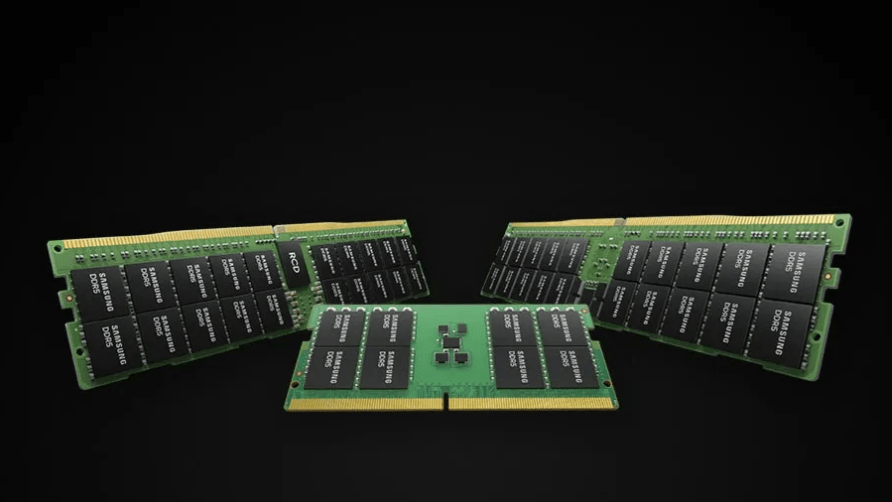
DRAM constantly leaks charge and must refresh continuously just to preserve data. Modern AI accelerators increasingly spend more energy moving data than performing arithmetic. Hyperscale GPU clusters are already running into power delivery and cooling limits. A non-volatile memory operating at picosecond speeds with minimal heat generation could reduce refresh overhead, lower cooling requirements, and blur the line between memory and storage.
Now the honest caveats.
This is firmly experimental. Tiny laboratory structures, not manufacturable memory chips. The current implementation still requires an external bias magnetic field for deterministic switching, which is a major practical limitation. Manufacturing scalability, endurance, cost competitiveness, and CMOS integration remain unresolved.
The history of computing is full of next-generation memory technologies that never displaced DRAM or NAND. MRAM, PCM, ReRAM, FeRAM, 3D XPoint. Each had a credible technical case. Each ran into manufacturing, cost, or scaling problems that kept it niche or killed it outright.
Still worth tracking.
The energy and cooling problem in AI infrastructure is real, and the curve is bending the wrong way. Even if this specific approach never commercializes, the broader lesson is important: future performance gains may depend less on shrinking transistors and more on reducing the energy required to switch states.
Want longer reads on these topics?
Insights covers the same topics in depth: research-backed analysis on AI, value creation, and building companies.
Read Zaruko Insights